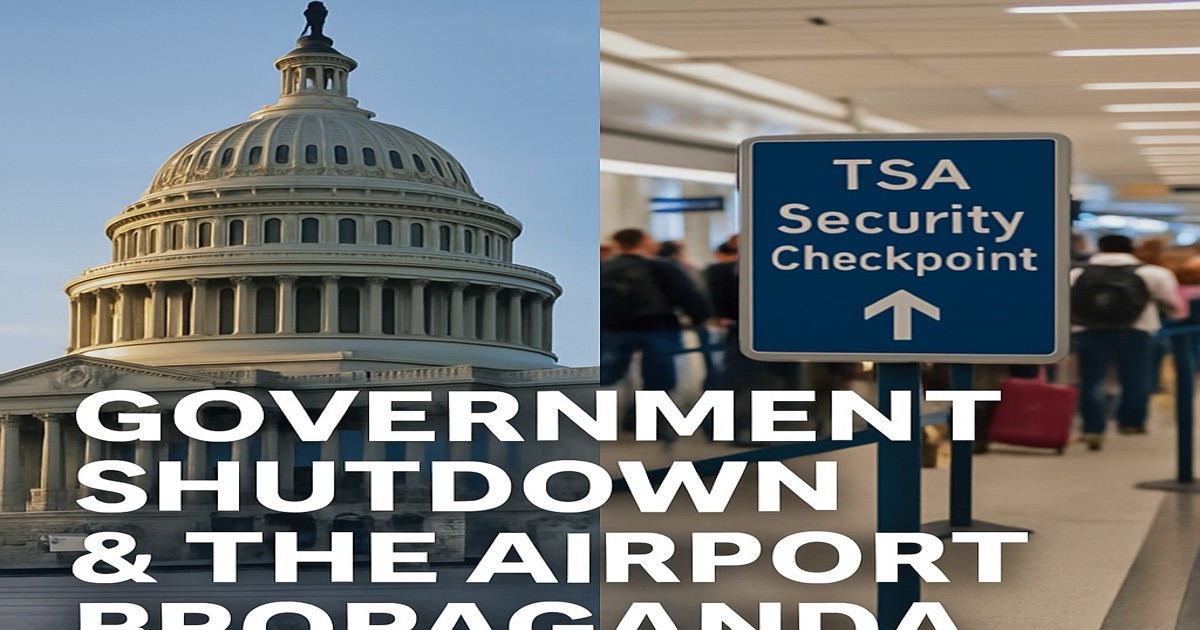
And can we talk about the messaging? If the government is shut down while official sites and channels are pushing “blame the other side” content, that still takes staff time and taxpayer money—writing, filming, editing, legal review, posting. Even if hosting is cheap, people’s time isn’t. Using public resources for partisan blame games during a shutdown is not just tacky; it dodges the real reason we’re here and it’s wildly unprofessional. I’d say the same if Democrats did it.
Here’s what I mean. At TSA security checkpoints, the Department of Homeland Security began airing a video that blames Democrats for the shutdown
And on official government websites—including the White House and multiple federal agencies—there are posts and banners pinning the shutdown on Democrats
Ethics experts are already raising Hatch Act concerns about using public resources for this kind of partisan messaging during a lapse in funding.
So here’s what I’m asking for right now: stop the PR stunts, cancel the recess, and withhold member pay until every affected worker is made whole. Stay in D.C., do the job in public, and finish the work.
How This Shutdown Is Being Weaponized—and by Whom
Some Republican strategists aren’t just “tolerating” a shutdown—they’re using it as leverage to force broader cuts and policy concessions. The most visible is Russell Vought (long tied to the Project 2025 playbook). His camp’s goal isn’t a quick deal; it’s to squeeze Democrats until they accept deeper reductions and rollbacks across government.
(I’ve written a plain-English explainer on Project 2025 from a Christian perspective—see
Project 2025, Faith, and Power.)
Health care is the biggest pressure point. Democrats want to extend enhanced Affordable Care Act premium subsidies and reverse recent Medicaid cuts. Without those subsidies, out-of-pocket premiums jump hard for millions of people—including a lot of fixed-income and disabled folks. And ignore the noise about “free health care for undocumented immigrants”—that’s not what this is; undocumented people aren’t eligible for ACA subsidies. See the details in
the section below.
At the same time, the administration has gone beyond the usual shutdown furloughs and begun layoffs (RIFs) at multiple agencies—an unprecedented escalation that unions and legal experts say may violate shutdown law. That move both raises the stakes and signals the point: use the shutdown to shrink government permanently, not just to negotiate a temporary funding bill.
What this means in practice: the longer the shutdown lasts, the more pressure builds to accept broad cuts—on health programs, domestic agencies, and long-term investments—while the people least able to absorb the hit are asked to carry it. That’s exactly why I’m saying: stop the games, escrow Congress’s pay, keep them in session, and pass an automatic backstop so shutdowns can’t be used as a hostage tactic again.
For a deeper dive on the military and law-of-war stakes—including what recent moves at Quantico signal—see
From a Moonlit Beach to Quantico.
What this shutdown fight is really about
In plain English: this shutdown is about health care. The core dispute is whether Congress will extend the enhanced Affordable Care Act (ACA) premium tax credits that have kept Marketplace plans affordable since the pandemic—and whether to reverse recent cuts to Medicaid. If those enhanced subsidies are allowed to expire at the end of 2025, people start feeling it in 2026 with much higher monthly payments
(KFF analysis).
That’s not abstract for families like ours. Between insulin and other meds, health coverage is survival, not a luxury. In Michigan specifically, insurers are already proposing sizable premium increases for 2026
Those are before you even factor in losing the enhanced subsidies. Take away the extra help, and fixed-income households get hit from both directions: higher sticker prices and less financial help to offset them.
For us, this isn’t theory. Josh and my older sister both take insulin. Medicare now caps insulin at $35 a month, but that doesn’t help everyone, and supplies (needles, sensors, pumps) still add up fast. Without solid coverage and subsidies, people skip doses or stretch meds—because they have to.
Republican leaders say they’re open to talking about the ACA subsidies—but only after the government is reopened, and without making guarantees. Meanwhile, some voices on the right want to use the shutdown as leverage for broader rollbacks. You may also hear claims that Democrats are pushing these subsidies to give “free health care to undocumented immigrants.” That’s false—undocumented people aren’t eligible for ACA Marketplace plans or subsidies, and they’re largely barred from Medicaid and Medicare
(KFF: immigrant eligibility basics).
And yes, “Obamacare” is the ACA. Trump has repeatedly promised to get rid of it over the years, but has never put forward a detailed replacement that covers as many people at comparable cost
(background and fact-checking).
The political reality is simple: repealing the ACA is unpopular, but letting its enhanced subsidies die quietly is a back-door way to gut affordability without saying “repeal.”
- If Congress extends the enhanced subsidies: millions keep affordable coverage; Marketplace enrollment stays high; premium hikes in 2026 are cushioned by bigger tax credits.
- If Congress lets them lapse: net payments spike in 2026, some people lose eligibility for any help at all, and many will be forced to drop coverage or skimp on care.
That’s why I’m backing the side that’s drawing a hard line on health care. Don’t use our medicine and our coverage as bargaining chips. Keep the help in place and stop turning people’s lives into hostage negotiations.
The airport propaganda campaign
While the people who keep airports running are working without pay—TSA officers and air traffic controllers—the administration began airing a video at TSA checkpoints that blames Democrats for the shutdown
DHS has confirmed the rollout; roughly 50,000 TSA officers and about 13,000 controllers are still reporting to work despite no pay.
Not every airport is going along. The Niagara Frontier Transportation Authority, for example, said it won’t play the DHS video because its policy bars partisan content on terminal screens
Local outlets around the country have also shown the clip or described its script, which tells travelers the shutdown is Democrats’ fault while assuring them operations will continue.
The messaging isn’t limited to airports. The White House website published an article headlined “Democrats Betray Americans with Government Shutdown”
and multiple federal agencies posted banners or notices blaming Democrats on their .gov pages. In prior shutdowns, agencies typically posted neutral service notices; using official platforms this bluntly as a partisan megaphone during a lapse is highly unusual—arguably unprecedented at this scale—and ethics experts are flagging potential Hatch Act and anti-lobbying problems.
Is it expensive? There’s no public price tag, but it isn’t free. Even a short spot requires salaried staff time—writing, filming, editing, legal review, and distribution—and coordination with the airport screen networks. The bigger point is the optics: if there’s bandwidth to script, produce, and push partisan videos and banners, there’s bandwidth to stay at the table and negotiate an actual funding bill.
And while the PR machine hums, Congress is still on recess—by choice. Next up: why that “vacation” decision matters, and how Speaker Mike Johnson could have kept the House in session
The “vacation” problem: Speaker Johnson sent the House home
Here’s what really fries me: during a shutdown that’s hurting real people, House leadership chose to keep lawmakers out of town. Speaker Mike Johnson sent members home and then canceled more votes instead of keeping the chamber in session to finish the job
The House wasn’t brought back into working session, and leadership signaled they wouldn’t recall members until there was a broader deal.
Let’s be honest: in any normal job, if you told your boss, “I’m not coming back until the problem fixes itself,” you’d be shown the door. You don’t clock out in the middle of an emergency and tell the crisis to email you when it’s over. How dare they treat a national shutdown like optional homework while workers miss paychecks and families lose services.
This isn’t some automatic, unavoidable “vacation.” Yes, the House publishes a yearly calendar with scheduled district work periods. But the Speaker controls the floor and can cancel recess or call members back. The posted calendar may show October work periods—but it’s leadership’s decision whether to cut them short when the government is closed.
Why does sending everyone home matter? Because the House is the bottleneck. Even if the Senate stays active, nothing moves until the House takes up and passes something. Saying “we’ll return when there’s a deal” gets it backwards—you get a deal by staying in town, negotiating in public, and putting bills on the floor. If there’s time to script airport videos and post blame banners on .gov sites, there’s time to hold votes.
There’s another piece that makes this look even worse. Arizona’s representative-elect Adelita Grijalva won her special election and has said the first thing she’ll do is sign the discharge petition to force a vote on releasing the Epstein files
Democrats accuse Johnson of slow-walking her swearing-in; Johnson’s allies blame shutdown logistics. Either way, her constituents still don’t have their vote on the floor.
What really grinds me is the double standard: blame Democrats on the way out the door, then keep the House on recess. You can’t walk off the job and point at the other side for not fixing it. If you want the government open, stay in town and vote. That’s leadership. This isn’t.
Next: let’s fix the rules so this can’t happen again—automatic backstop funding, escrowed member pay, and a no-recess rule during shutdowns
Stop the games. Fix the rules.
Shutdowns aren’t acts of God; they’re the predictable result of lousy rules that reward brinkmanship. If the rules make hostage-taking pointless, the shutdowns stop. Here’s what would do it.
- Automatic funding backstop (no more shutdowns). If Congress blows the deadline, last year’s funding continues automatically so paychecks and services don’t stop. Limit “new starts” and shiny add-ons during the backstop to keep pressure on leaders to finish real appropriations, but do not punish workers or the public.
- Escrow member pay and freeze perks. Don’t cancel congressional salaries mid-term (that runs into the 27th Amendment); escrow them until the lapse ends and every affected worker is paid. While we’re at it, freeze non-essential member travel and office extras during any lapse. If workers feel it, Congress should feel it first.
- No-recess rule during a lapse. When the government is closed, Congress stays in session—period. Daily recorded attendance, open debate, committee markups running, and votes on the floor until the lights are back on.
- Fast-track “clean CR” votes. If a clean continuing resolution (no side deals, no poison pills) reaches a supermajority of co-sponsors in either chamber, it must get an up-or-down vote within 48 hours. No more bottling up consensus to appease a faction.
- Protect workers and contractors. Essential workers who must report get timely pay (not IOUs) via the backstop. Furloughed feds keep guaranteed back pay. Create a contractor relief fund so low-wage contract workers (custodial, security, food service) aren’t wiped out every time politicians grandstand.
- Neutral public communications only. During a lapse, .gov sites and federally controlled screens (including airport networks) are limited to neutral service notices and safety information—no partisan blame campaigns, no “war room” messaging on the public dime.
- Transparency scoreboard. A daily public dashboard showing the number of furloughed workers, delayed services, estimated economic losses, and the roll-call of who showed up to work on the Hill. Sunlight sharpens accountability.
- Real deadlines before September 30. Force leadership to convene a budget conference on time and report progress monthly. Miss those checkpoints and the no-recess rule kicks in early—before the cliff.
This isn’t partisan; it’s basic governance. Keep the government open, keep workers paid, keep Congress in the room, and make brinkmanship a waste of time. (And yes—many of these ideas have already been proposed in Congress in some form, from automatic CRs to escrowed pay.)
Do the job
This isn’t complicated. The shutdown fight is about health care and whether millions keep affordable coverage
(what this is really about). While workers go unpaid, the administration is pushing blame videos at airports and banners on .gov sites
(the propaganda campaign). And the House? Sent home on purpose
If you can find the staff hours to script and push partisan messaging, you can find the hours to keep Congress in session and vote. You don’t walk off the job and point at the other side for not fixing it.
So do the obvious things: keep the government open automatically, escrow member pay during any lapse, ban recess while workers are unpaid, and keep official communications neutral
(fix the rules). Stop turning people’s medicine, rent, and food into bargaining chips.
I’m with Josh on this one. Protect health care, stop the PR stunts, and stay in D.C. until the government is open and every worker is made whole. That’s the job. Do it.

 Notes from the edge of the system